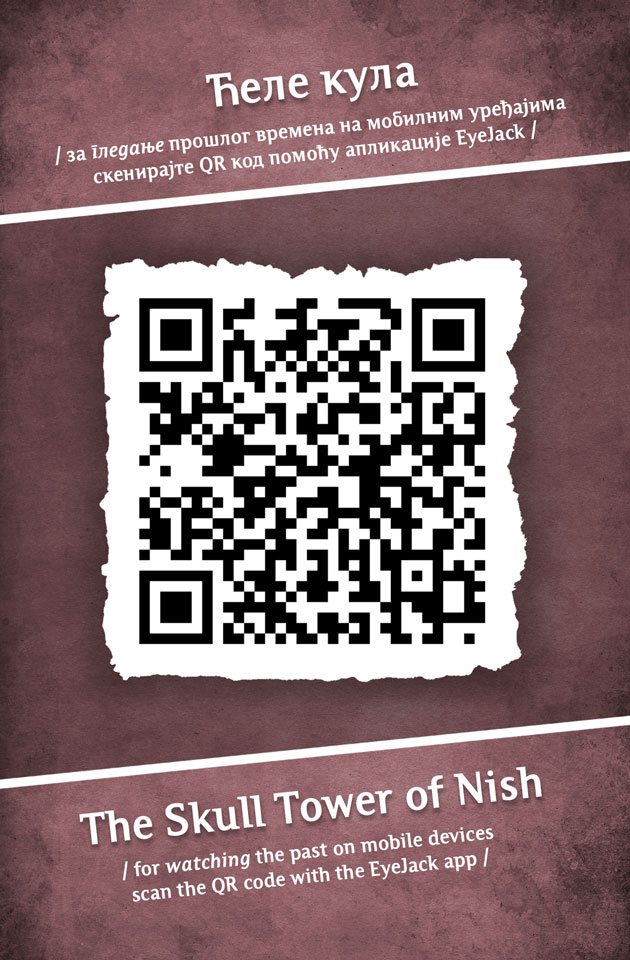
Virtual Exhibition / The Skull Tower of Nish
Thursday-Thursday / AUGUST 24 – SEPTEMBER 7, 2023 / Cultural Center of Nish / Officers’ Club
Back in 1809, the struggle of the Serbian people for liberation from the Ottoman Turks had reached a stalemate. The First Serbian Uprising had begun six years earlier, and capturing Nish was a crucial task as with it the revolutionaries would have gained a passage to Kosovo and the heart of old Serbia. Thus, an ordinary hill with an unusual name – Chegar, overlooking Nish in those days of yore, became the nucleus of insurgent hopes, as well as the place of its deepest defeat and the turning point in this rebellion. Leading the Serbian army gathered hastily from all walks of life in the trenches at Chegar was the rebel commander Stevan Sindjelic. The outnumbered rebel army faced a 36,000-strong force of Turkish imperial guards. Rather than surrender or flee they decided to put up a desperate last stand at Chegar Hill. The hopeless battle showed no signs of ending. The Turks launched four assaults, only to be stubbornly repelled by Sindjelic’s fighters time and again. However, the Ottomans inevitably began to push back the Serbian forces. The artillery assaults transformed into a desperate struggle with buttstocks, blades, and ultimately bare hands. Fresh Turkish forces seemed to emerge from an inexhaustible source, while the rebels’ numbers dwindled. Faced with imminent annihilation, the rebel commander Stevan Sindjelic played his final, desperate card. He fired a single shot into a fully stocked gunpowder room, blowing up his entire army as well as wiping out enemy soldiers who were already flooding the rebel trenches. Stevan Sindjelic and all his insurgents perished that day. A total of 4,000 Serbs lay dead in the Chegar trenches. Despite it all, the final tally was actually in favour of the insurgents – for every fallen Serbian soldier, four Turks who thought they could easily handle the pitiful serfs were killed that day.
Deeply angered by the rebel force’s actions, the Turkish commander Hurshid Pasha decided to teach the Serbian nation a lesson they wouldn’t dare to forget. The skins were flayed off the dead rebels’ decapitated heads, stuffed up with straw, and sent to the Imperial court in Istanbul as proof of Turkish victory. The skulls became the building blocks for a tower built by the main road at the entrance of the city, a warning to all who survived and a stark reminder of the cost of rebellion. A total of 952 skulls rose 4 metres high facing all four cardinal directions. At the top of the tower, the skull of Stevan Sindjelic was perched like a crown. However, in spite of this gruesome act, the Serbs rose once more, and Serbia was finally liberated a few decades later.