Approaching Obrenoviceva Street
Virtual Exhibition / Approaching Obrenoviceva Street
Thursday-Thursday / AUGUST 24 – SEPTEMBER 7, 2023 / Cultural Center of Nish / Officers’ Club
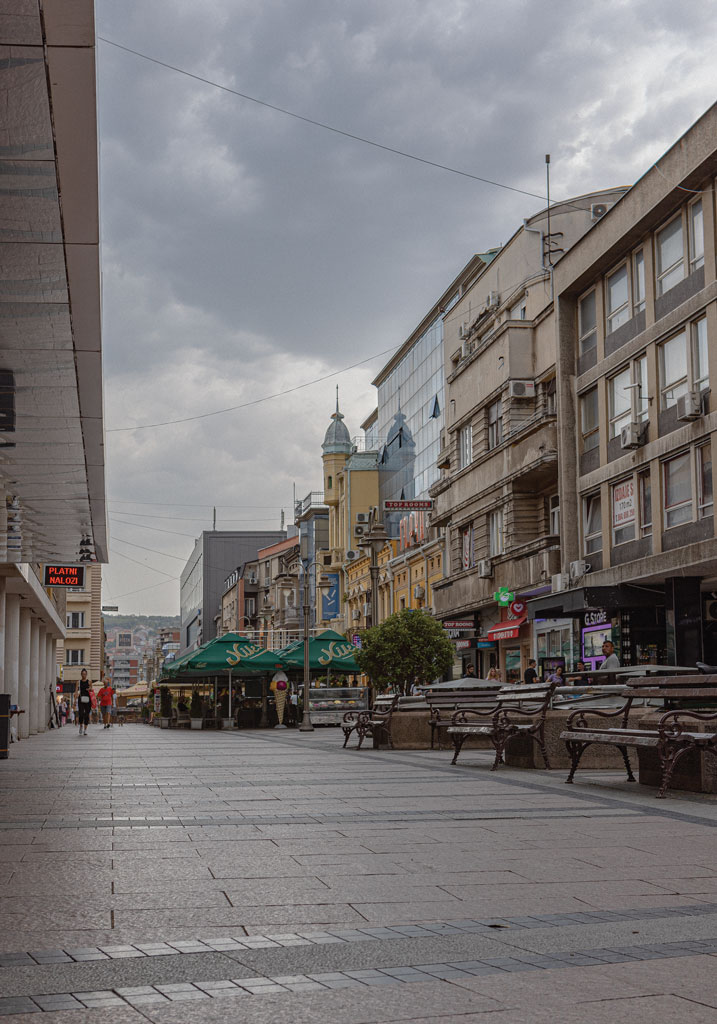
Starting from the fortress bridge and the Nishava River, stretching through the heart of Nish towards Gorica and Gabrovac, a trade street began to form in the distant 15th century. Later, during the 18th century, it came to be known as the “Covered” Street, its name inspired by the overhanging roofs of the shops that protected their customers from rains and the scorching sun. After the city gained its independence from the Ottomans, this sidestreet expanded and straightened, abandoning “cepenci” (retractable wooden awnings) and giving rise to shops that became more European in appearance. Although it was known among the people as the Main Street, during this period it received a new name – Obrenoviceva (Obrenovic’s), named after the Serbian dynasty that was deeply respected throughout southern Serbia for their role in the battles for independence. This name remained until the end of World War II. After the war was over, it was named Victory Street), then Marshal Tito’s Street, and again Victory Street, before reclaiming the name “Obrenoviceva” at the turn of the 21st century.
Between the two World Wars, Obrenoviceva Street underwent rapid modernization. New palaces, taverns, and European-style arts and crafts shops sprung up along the street. There are several interesting buildings constructed in line with the trends of that period at the very entrance to the street. Among them are the former Nisim Palace and a series of buildings that have become the “Gorcha” shopping centre. The Nisim Palace was ordered by the Nisim brothers, traders from Nish, at the beginning of the 20th century in the spirit of modernism. It was built on the site where a hammam (Turkish bath) and a butcher’s shop named “Era” stood during the Ottoman period. The Nisim brothers, Moric, Raul, and Chibi, inherited some and bought other properties that once stood on the site of the palace. On the ground floor of the building, they sold glassware from Nuremberg in a shop called “At the Louvre,” fashionable clothing under the brand “At 100.000 shirts”, and the aroma of freshly brewed coffee always wafted from another shop. The top floors were arranged for residential use. You can infer its purpose based on the sheer volume of this three-story building. Shallow facade grooves were placed between the windows, and they, along with the interplay of the first and second-plane façade levels, and the rounded edges of the balcony corners and the third floor, visually reduced its imposing size and made it seemingly less impregnable in spite of the already popular use of concrete. The entire Nisim family perished during World War II. The Nazis executed each and every one of them at Bubanj in 1942.